
Growing a Japanese maple is relatively easy, with the tree hardy to a lot of punishment. It loathes too much water but will be one of the first to show you if you happen to miss a watering. This will keep you on your toes a little over the warmer periods in the season. I will usually bring my maples into a semi-shaded area for the summer to give them some protection. This gives me a chance of a good autumn show.
Once our Japanese maples have matured as bonsai with a highly refined canopy, there are maintenance techniques that we need to perform in order to maintain the health and vitality of inner buds and branches of the tree. This is where defoliation and partial defoliation techniques are employed. Acer palmatum is a strong hardy tree and can handle full defoliation as long as it healthy (as does trident maple). Japanese maple varieties tend not to be as hardy, and don’t handle full defoliation well, so partial defoliation techniques are required.
Two partial defoliation techniques are known as hasukashi and hagiri in Japanese.
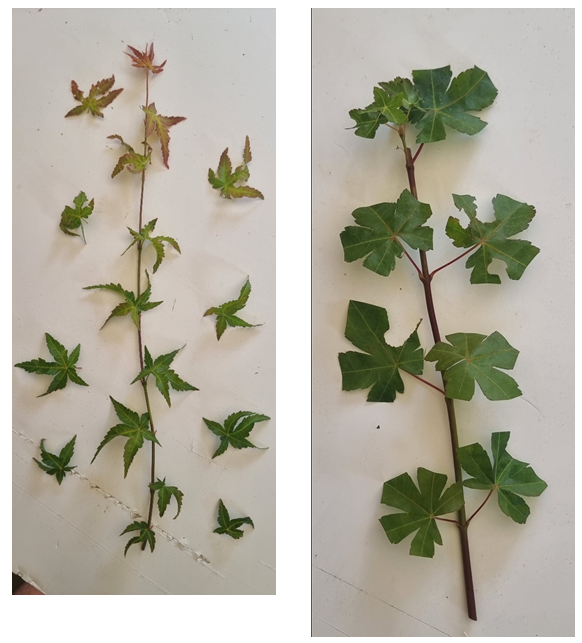
Hasukashi (photo left) is the thinning out of foliage, where the larger leaf in the pair of leaves is cut off completely, leaving the smaller of the two leaves at that junction (Japanese maple are an opposite leaf pattern). Hasukashi, is the basis for cultivation of mature bonsai Japanese maple canopies and can be used alone or in combination with hagiri. Both techniques are specific to the Japanese maple and shouldn’t be transferred to the Trident maple. Performing hasukashi will open it up to light and air, keeping internal branches healthy.
Hagiri (photo right) is the cutting of the leaf to a smaller shape by cutting off the leaf ’fingers’ or lobes. Both leaves of the pair are cut at each internode rather than just removing one leaf completely (hasukashi). This allows light and air through to the ancillary buds but also reduces the photosynthetic surface and therefore the ability of the leaf the produce ‘food’ for the tree. Simply fold the leaf in half along the centre line like a butterflies’ wings and cut into a smaller shape. Hagiri is an essential technique for Japanese maples varieties with broader leaves (moon maples) or those with heavy foliage masses (shishigashira).
As mentioned, either technique can be used alone or in combination. This would be where hasukashi is performed first across the tree and then hagiri is performed on the remaining leaves to further open up the tree to light and air. The choice will depend upon the circumstances on that particular tree. A strong densely ramified area of a tree may need both techniques whereas the rest of the tree only hasukashi. Or those big broad leaves of a moon maple that are still providing too much shade need hagiri technique to open the tree up more.